Tuesday, February 20, 2018

Do you love shoes? Let's fly to Florence

Dear friends and fans,
Today we travel to Florence to talk about one my most favorite fashion items:  Shoes !!!

All of you that love fashion, know for sure that the “Big Four” fashion capitals of the world are Paris, Milan, London, and New York. While Milan might get the credit for Italy’s fashion trends, Florence is no slouch itself. 


In matter of fact, many trendsetting designers such as Salvatore Ferragamo, Emilio Pucci, Gucci, and Roberto Cavalli all were either born in Florence, Italy  or moved there during the height of their careers. And all four brands still maintain their headquarters here. 
If you absolutely positively can’t get enough of shoes, like me, you’ll definitely want to stop by the "Salvatore Ferragamo Museum" next time you are visiting Florence.


The  Salvatore Ferragamo Museum  opened in May 1995 and is housed in the historic Palazzo Spini Feroni, which was purchased by Ferragamo in the 1930s. The Fashion Museum is dedicated to the life and work of Italian shoe designer Salvatore Ferragamo and his successful company. 

The Museum houses over 10,000 pairs of the esteemed luxury designer’s footwear, shoes created and owned by Ferragamo from the 1920s until his death in 1960. Following Ferragamo's death the collection was expanded by his widow and children. The museum also includes films, press cuttings, advertising materials, clothes and accessories from the 1950s to the present day.
Salvatore Ferragamo with Audrey Hepburn 

The red stiletto shoes wore by Marilyn Monroe in the movie "Gentlemen Prefers Blonds" 


One of my favorite part of the museum is the wooden lasts made by Ferragamo for his most famous clients, like Marilyn Monroe, Sophia Loren, Lauren Bacall, Marlene Dietrich, Angelina Jolie and almost all the big Hollywood stars of the last 70 years. 


These are basically a wooden model of the dimensions of these people’s feet so that the shoemaker can create perfectly fitting shoes for his client.

This would be right at home today Ferragamo was really ahead of his time.

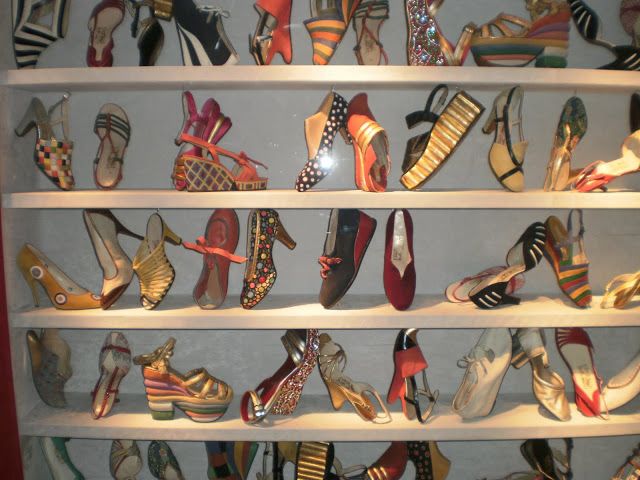
Nylon thread shoes with the Ferragamo signature wedge. Many of the shoe designers today are inspired by Ferragamo

Innovative. Ferragamo used rafia for the upper and then cork for the heel of this shoe. This was made somewhere between 1936- 1938.


The shoes are rotated out on a bi-annually basis, so you’ll always have 10,000 new reasons to visit Florence again. And they have always exhibition dedicated to some of their famous clients. One of my favorite was when in 2012, for the 50th anniversary of the death of Marilyn MonroeSalvatore Ferragamo inaugurated, a retrospective dedicated to the actress.
Marylin Monroe was a huge fan of Salvatore Ferragamo and owned many of his shoes


Made in 1957 for Marilyn Monroe.


The Marylin Monroe collection 


Marilyn Monroe’s court shoe in crocodile and suede. Made between 1958- 1959 specifically for her.


Salvatore Ferragamo was really a visionary. He was born in  1898 in Bonito, Italy, near Naples. After making at age nine his first pair of shoes for himself, and a pair of high heels for his sister  to wear ar their confirmation, young Salvatore decided that he had found his calling. After studying shoemaking in Naples for a year, in 1914, he emigrated briefly to Boston to work on a boots factory. After a year he convinced his brother to mover to Santa Barbara, CA, The following year they settled  in Hollywood, CA.  


Here he  opened a little store for repair and made-to-measure shoes.  It did not take long, before it became the favorite place for Hollywood people to go for shoes. He soon became  known as the "The Shoemaker of the Stars". But, as he said himself, it was something of "destiny" for him to move back in 1927 in Florence, Italy. After studying anatomy he started to make shoes that were beautiful for the eye yet not hurting the foot.
The famous 18K gold shoes commissioned for the wife of a Aussie tycoon (1956) .
Salvatore Ferragamo fitting his 18kt gold sandals!

Salvatore  Ferragamo patented metal arch support in 1931 was the begin of the  modern age shoes. Not only fashion but also science, he had revolutionized the shoe making. Equilibrium was also behind the creation of the first modern wedge in 1938.


To the left 1938 Maharani wedge sandal made for Indira Devi, Maharani of Cooch Behar and to the right the Rainbow suede platform sandals designed for Judy Garland, 1938,  as s a tribute to Judy Garland’s signature song “ Over the Rainbow" performed in the 1938 feature film, "The Wizard Of Oz". 


He was always innovative and experimenting new materials for his shoes. In 1947 he also created the invisible sandals with fishing wire, famously owned also by Marilyn Monroe.


Ferragamo was the first shoemaker to use cork for heels.


The remarkable "cage heel" created by Salvatore Ferragamo.
  
And the same studies were also behind the creation of his famous and popular "stilletto" shoes, also wore by Marylin Monroe. 
Here also is a very interesting video about Salvatore Ferragamo and the invention of his famous stiletto.

https://www.youtube.com/watch?v=nTw0sbWb0VY
I have the honor to be sponsored for some of my Concerts and events by Salvatore Ferragamo. And I have had the pleasure to meet Massimo Ferragamo on several occasions. To wear their elegant shoes and accessories makes you feel like a princess. It's like wearing a true Made In Italy treasure.


With Massimo Ferragamo 


One of my precious Salvatore Ferragamo shoes.

While in Florence I really would suggest you to make a stop at the Ferragamo Museum.  You will be taken aways by the beauty of the Florentine building, which also functions as flagship store and headquarter for the brand, and you will surely experience  an unique opportunity to see such an amazing collection of rare shoes from the archives of Ferragamo.

If you’re visiting Florence and you love fashion this is a place you don’t want to miss for sure.

Thank you for reading and if you enjoyed subscribe to my BLOG and leave me your comments. 

Giada 


Join me on my official mailing list www.giadavalenti.com  to be part of my world of lovers of love and to stay connected with me.

Friday, January 5, 2018

Long life to the Befana!


Today, January 6th is La Festa della Befana.
All children in Italy will be singing  the nursery rhymes about Befana –

La Befana vien di notte

Con le scarpe tutte rotte

Col vestito alla romana
Viva, Viva La Befana!


The English translation is:
The Befana comes by night

With her shoes all tattered and torn

She comes dressed in the Roman way
Long life to the Befana!


It is basically the date on which the 3 wise men finally arrived at the stable in Bethlehem to offer Jesus gifts of gold, incense and myrrh. In Italy, according to Christian tradition, we celebrate an holiday called Epiphany, Epifania in Italian.

It is an extremely important part of the Christmas festivities, and Epiphany, Epifania o Festa della Befana,  is a public Holiday so government offices, post offices, banks, schools and other educational institutions are closed.
Epiphany is just as important as Christmas itself and is a big day for celebrating and exchanging presents. But to bring the presents it is not Santa Claus (Babbo Natale), but a witch called Befana, or in Venice  “Marantega”, who flies on a broomstick. She is also often covered in soot, as just like Santa Claus, she delivers presents through the chimney. It is also believed that she also sweeps the floor before she leaves as a way of sweeping away last year’s problems.
So just who is the Befana?

Legend has it that the three kings stopped to ask the Befana for directions to Bethlehem, but she didn’t know it. But she offered to put them up for the night.  The next day the wise men invited the Befana to travel with them, but she said she had too much housework to do, and did not go with them.

But the Befana could not stop thinking about the invitation and eventually decided to follow the kings to find Jesus. She carried a sack filled with bread. Whenever she saw a child, she was giving him a piece of bread hoping he might be the Christ child.
Sadly, though, Befana never managed to catch up with the wise men and never found the stable in Bethlehem. So she is still wandering through Italy on her broomstick looking for the baby and leaving goodies for children.

There is also a second legend that states that the Befana could originate from the Sabine or Roman goddess named Strina, as Romans used to give presents of sweets to celebrate the new year. Her name means “gift-bringer”.
Just like at Christmas, children leave stockings out on the evening of 5th January hoping that the Befana will leave presents and sweets. They also often leave the witch a snack of something soft to eat, as she has hardly any teeth!
But if children haven’t been good they risk just being left a lump of coal or a stick. Nowadays days the coal is a rock candy called “carbone” made from caramel, which I always found very delicious.

Parents still use the threat of the Befana to ensure good behavior for the kids. The saying “Lo dico alla Befana!” (I’ll tell to the Befana), or the terrifying “Viene la Befana e ti porta via!” (the Befana will come and take you away)!!  Its enough to scare even the naughtiest child as the Befana is well-known to have a terrible husband who likes to devour children!! Always got me as a child…


Apart from presents, festivities take various forms around Italy. In my region, the Veneto, we lit wood bonfires or roghi or foghere,  on the night of the 5th January to tell the future from the direction of the smoke.

The highlight in Venice, however, is definitely the Regata delle Befane, the regatta of the witches, that takes place at 11am on the Grand Canal. It’s a very fun regatta. Retired gondoliers and Bucintoro rowing club members dressed as old Befana’s  or vecie maranteghe in the Venetian dialect and race between San Tomá and the Rialto Bridge where a large stocking is hung from the parapet.


A band plays at the feet of Rialto bridge throughout the morning. 


Hot chocolate, vin brulé (warm sweet wine,  and sweet biscuits are handed out to the crowds of spectators by the Pink Lionesses rowing club as they wait for the Befane to arrive.


Around town, patisseries also sell fried doughnuts with dried fruit in and mammaluchi /fritters with raisins as a traditional treat for locals to eat along with their hot chocolate.

And as with all  the Venetian regattas, the winners are awarded silk pennants.


Stockings filled with sweets are also handed out for free to children at the Fish Market near the Rialto Bridge. Kids can have their photos taken with the Befana and everyone can have a hot chocolate, hot wine, chunk of pandoro cake or handful of peanuts for a donation to the Rialto Association.

Its also worth taking a walk over to St Mark’s square on this day, where there is a special procession of an angel and the wise men above the clock on the Torre dell’Orologio in tribute to the Madonna and child. The wise men process every hour, on the hour but can only be seen on Epiphany and in May for the Ascension so don’t miss them if you are in my hometown.

(The statues are often on display inside for visitors to the clock tower but only process twice a year).

Other cities have different traditions. If you are in Florence they have a large parades headed by the 3 wise men on horseback - La Cavalcata dei Magi. 

Rome has a large market in Piazza Navona where toys, sugar charcoal and other candies are on sale.


And in Urbania, believed  to be Befana’s official hometown, some 30,000-50,000 people attend the festivities to watch as hundreds of Befanas fly down from the main tower.
So Happy Befana.
And he is to a New Year great year. 
Giada 

Join me on my official mailing list www.giadavalenti.com  to be part of my world of lovers of love and to stay connected with me.


-->